Perimeter Sensing Requirements
What sensor performance does a perimeter need to detect a small uncrewed aircraft early and hold its track? The public literature answers with vendor datasheets and isolated field trials. This study puts it to SimOS: those bands go in as the input space, 2,239 deterministic runs sweep a characteristic 4 km airport-perimeter segment across geometry, sensor bands, and threat, and the requirements come out — mesh spacing, cue standoff, track continuity, cue-to-layer handoff — each with the input band that drives it.
The answers, against the binding case
The binding case is the receive-only micro-UAS at 15 m/s: no emitter for a passive-RF sensor to hear, the smallest radar cross-section and quietest source level in the surveyed bands.
- Fence coverage — an acoustic mesh at ≤ 218 m spacing (150 m at the surveyed range floor) keeps every fence crossing inside a node's reliable range.
- Early detection — one radar node of 1.5 km reference range gives 3,010 m of cue standoff: 201 s of warning at 15 m/s, 50 s at 55 m/s.
- Reliable tracking — the radar track holds through a 2 km standoff loiter (gap fraction 0.04) and fragments at 3 km (0.64).
- Cueing — the radar cue hands the track to the fence-line layers 178–194 s ahead of their own confirm.
The passive-RF cue matches the radar only at FCC-mode emitter power (3,070 m) and is worth 190 m at CE-mode power. A larger airframe relaxes every passive requirement: the mini fixed-wing is confirmed at 5,275 m by the same radar and at 452 m by the same acoustic node.
An aircraft broadcasting Remote ID that strays across the perimeter is read analytically, not simulated: a beacon receiver picks it up at 396–7,924 m, depending on the receiver and the broadcast transport.
What you are watching: a single deterministic run against the receive-only micro-UAS at 15 m/s, clipped to the 290 s in which every confirm happens. The radar carries range, so it draws a track with its covariance ellipse; the EO/IR and acoustic nodes measure direction and synthesize no range, so they draw lines of bearing whose shaded width is the measurement’s 3σ angular uncertainty. The radar confirms first, far out; the fence-line rays only swing onto the target as it arrives.
Near the node the acoustic ray lags the aircraft and swings through as it passes — that is sound still in flight, not a drawing artifact. The replay is the run log itself, re-rendered; re-running the scenario with the same seed reproduces it exactly.
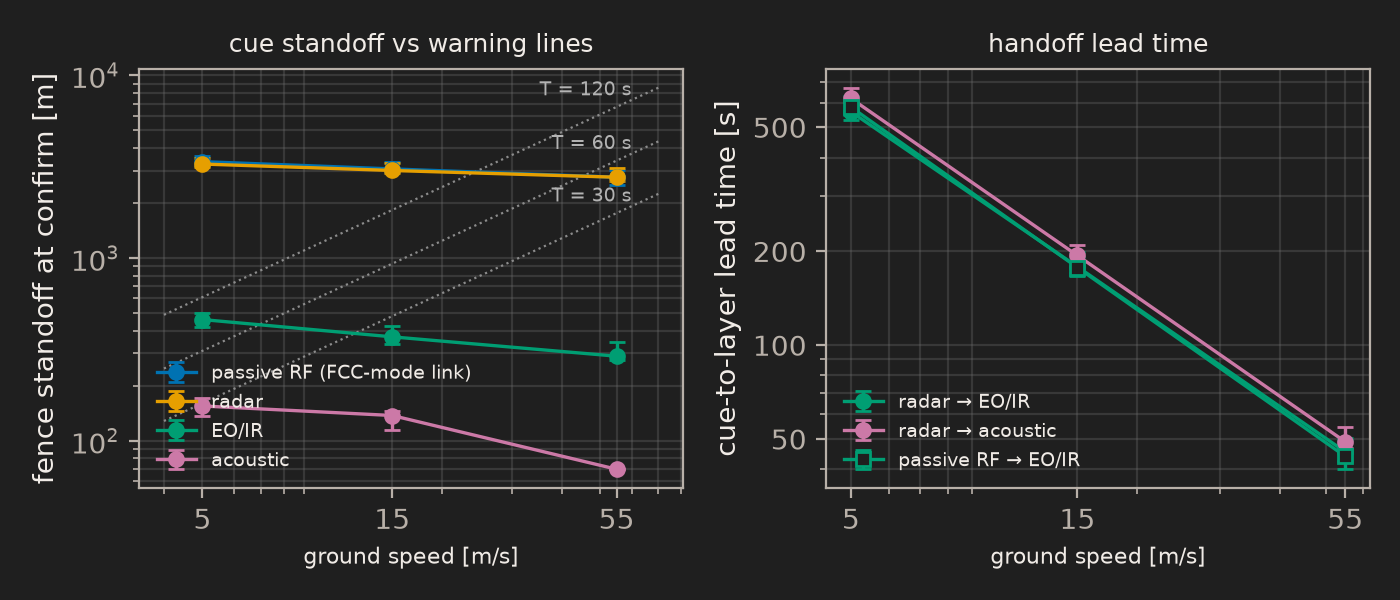
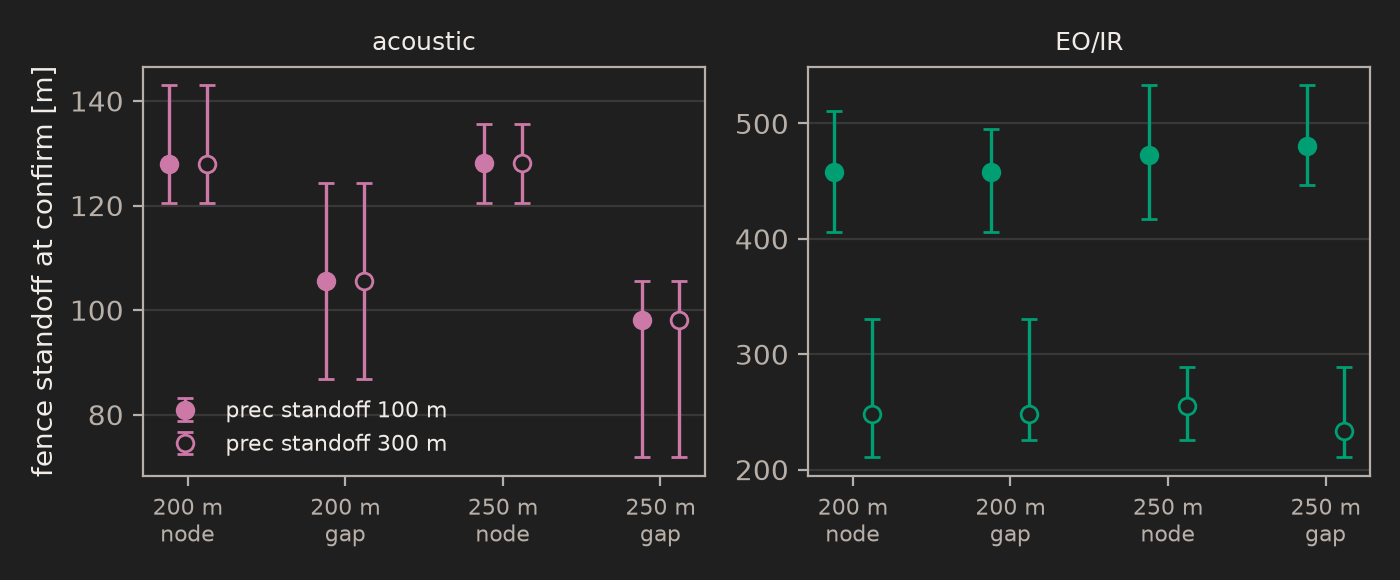
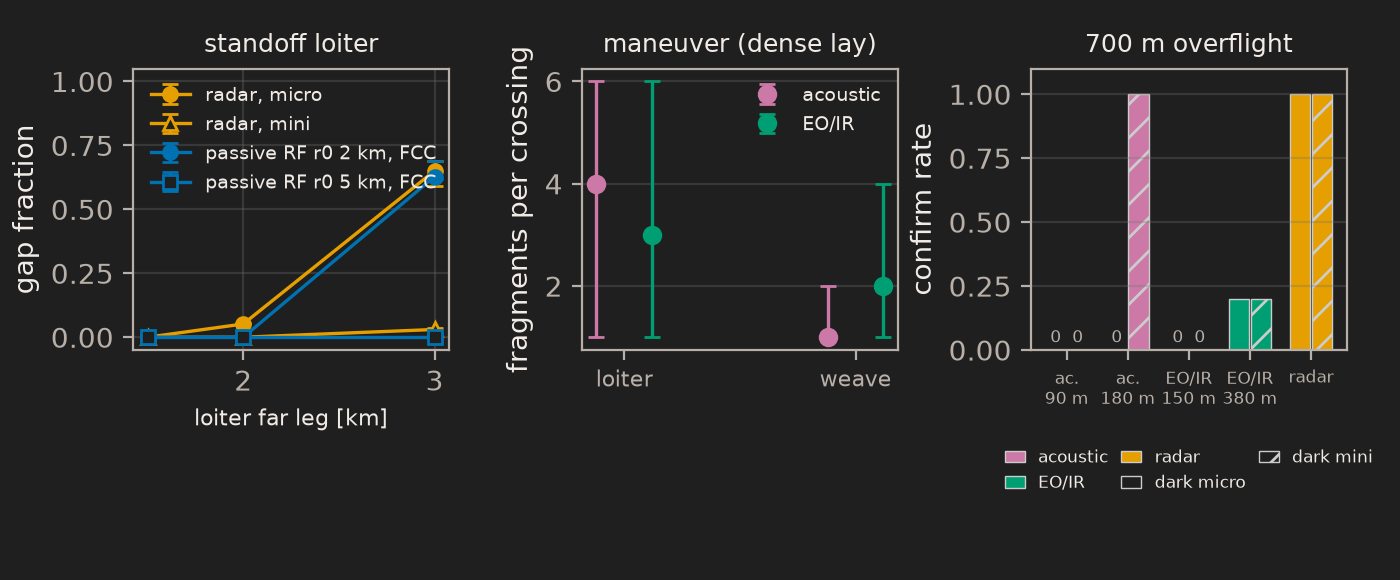
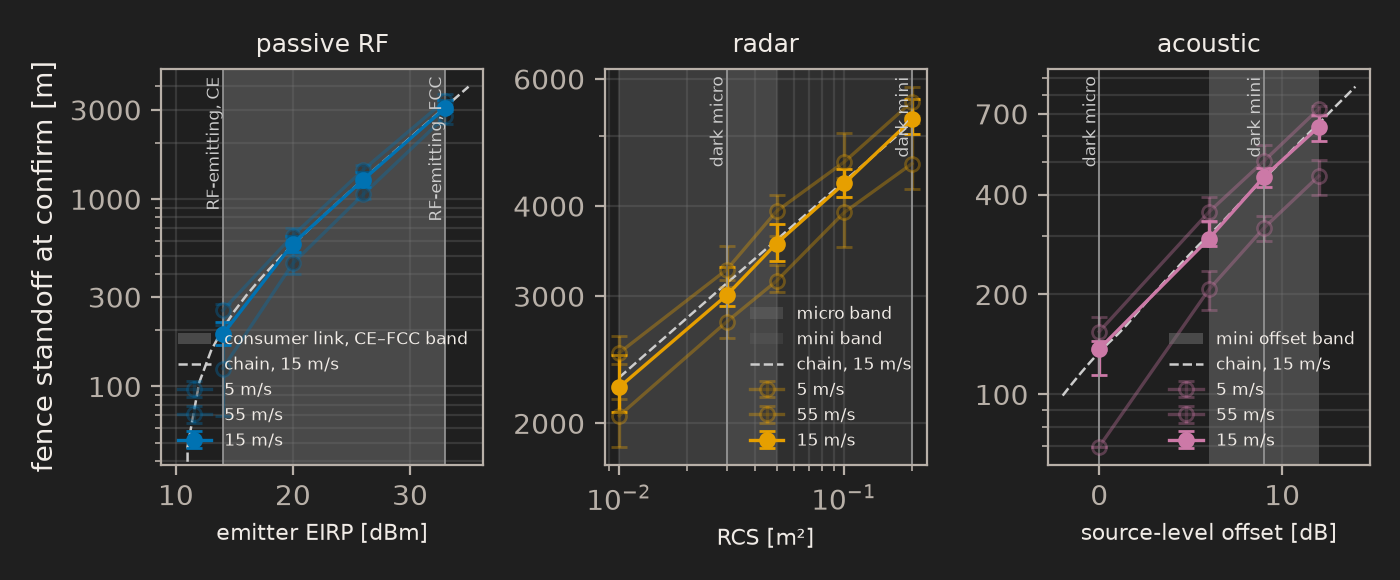
How the numbers are produced: each sensor modality — passive RF, radar, acoustic, electro-optical/infrared — is modelled as a banded statistical sensor with exact detection statistics, and the threat as a signature vector (radar cross-section, acoustic source level, emitter EIRP) swept continuously across the cited bands, with the discrete threat classes of counter-UAS practice marked as points on those axes. The campaign sweeps lay geometry, sensor bands, and threat signature, speed, and maneuver across 11 study documents; every run is seeded and reproduces byte-identically.
A closed-form prediction from the tracker's confirmation rule reproduces the campaign medians within the seed interquartile range at 20 of 21 validation points, and gives range-versus-sensitivity curves on which any radar or receiver can be placed from its datasheet. Track accuracy and sensor fusion are outside the study's scope. The dominant sensitivity in every case is the modality's detection-range band, whose public basis remains thin.